Reflection puzzles: real optics, learned by accident
Nobody opens a light-routing game to study physics. But an hour in, you are predicting reflections, filtering wavelengths, and splitting beams, which is to say: doing optics.
Reflection puzzles encode real optical principles as game rules: mirrors follow the law of reflection, colour filters pass only their own wavelength band, and prisms split light into components. Playing them builds genuine intuition for how light behaves. Lumear packages all three into a calm three-round daily on iOS and Android.
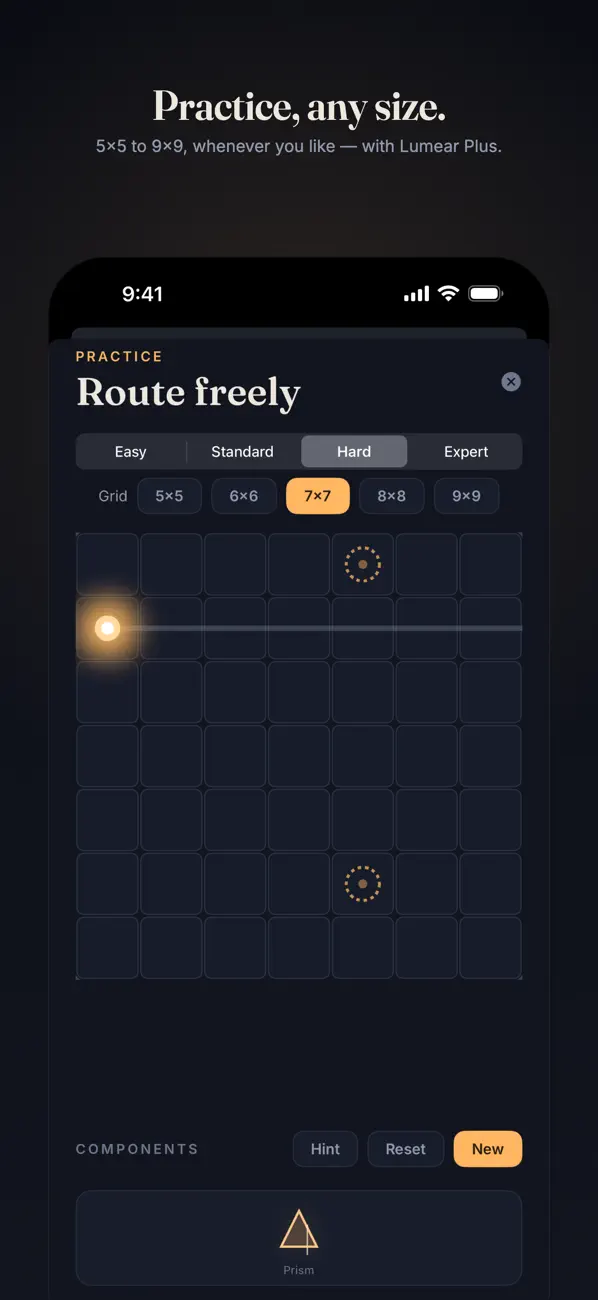
The physics hiding in the rules
Every classic piece in a light puzzle is a physics demonstration wearing a costume. The mirror enforces the law of reflection: angle in equals angle out, the first thing every optics course proves. The colour filter is subtractive filtering: white light goes in, only the filter's band survives. The prism is dispersion and beam-splitting, the same behaviour that hands you rainbows. When a game keeps these honest, every solved board is a tiny experiment with a confirmed prediction.
Why games teach this better than diagrams
A textbook shows you one reflection, once, labeled. A puzzle makes you predict hundreds of them, and grades every prediction instantly by drawing the beam. That loop, guess, test, watch, is how physical intuition actually forms. Lumear's habit of retracing the finished route matters here: you do not just learn that your answer was right, you watch why, turn by turn.
- Round one, mirrors: reflection angles, until they are reflex.
- Round two, filters: colour as a property light carries, not a paint applied at the end.
- Round three, prisms: one beam becoming several, conservation of the route.
For parents, teachers, and the curious
A daily light puzzle is a gentle sidecar to any physics curiosity: short enough for a homeroom minute, honest enough that the intuitions transfer to lab benches and ray diagrams later. It is not a course and does not pretend to be. It is a hundred small predictions a month about how light behaves, which is more than most of us made in school.
The honest boundary
Game optics is idealized: grid angles, lossless mirrors, tidy splits. Real lenses have aberrations, real mirrors absorb a little, real prisms disperse continuously. The simplification is the point; it isolates the rules worth internalizing. Just do not cite your streak in a physics exam.
Frequently asked questions
Can a puzzle game really teach optics?
Is Lumear suitable for kids?
Route today's light.
Three quiet puzzles a day. Free on iOS and Android; the light is patient.