Light beam puzzle games, and why routing light feels so good
A beam waits at the edge of a grid. A target waits to be lit. Everything between them is your problem, and solving it is weirdly, deeply pleasing.
A light beam puzzle game asks you to guide a beam from its source to a target by placing or rotating optical pieces: mirrors bend the path, prisms split it, filters change its colour. Lumear is a free daily version: three routes a day, no timers, with a beam that traces your solution when you get it right.
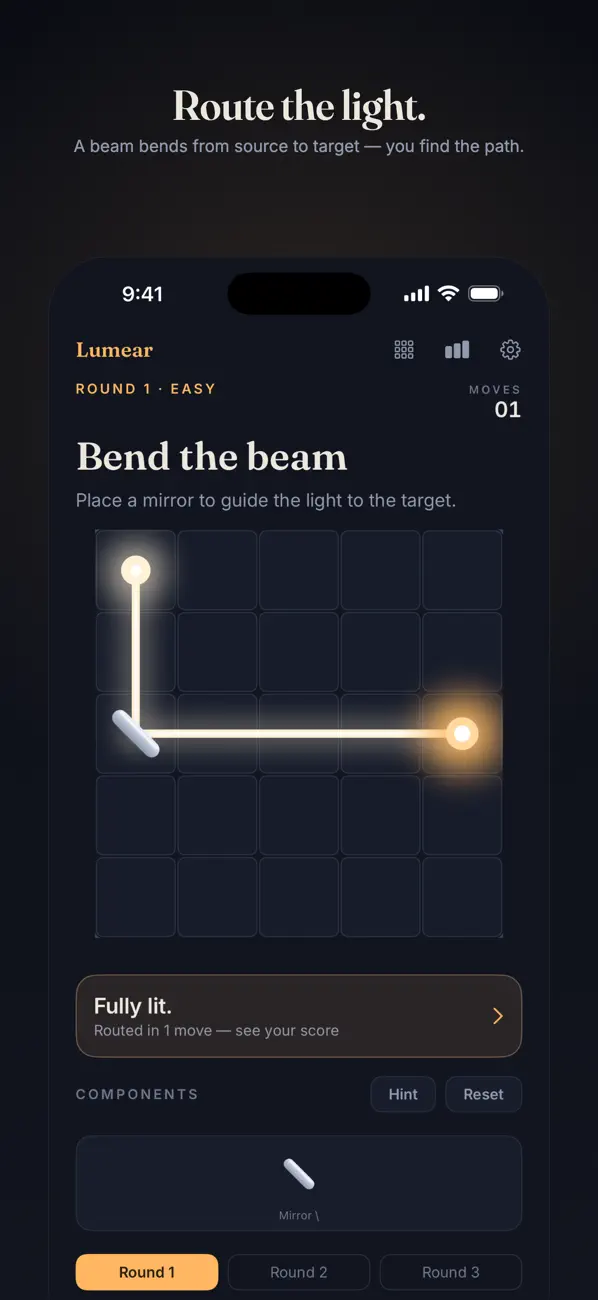
How light beam puzzles work
The genre has one rule and infinite arrangements: light travels in straight lines until something interrupts it. You are given a source, one or more targets, and a small optical toolkit. Mirrors reflect the beam at an angle. Prisms split one beam into several. Filters tint it, and coloured targets only accept the right shade. The puzzle is the gap between where the light is and where it needs to be.
Why the payoff lands every time
Most logic puzzles end with an answer. A light-routing puzzle ends with an event: the beam actually travels, turn by turn, through everything you built. Lumear leans into that moment deliberately. You place your mirrors and prisms in stillness, and when the route is right, the light retraces the whole path and lands. The act of solving is the reward, and you get to watch it happen.
- Round one: a simple bend. Place a mirror, find the path.
- Round two: colour. Route the beam through a filter so it arrives in the right shade.
- Round three: a split. One prism, two beams, every target lit.
- Fewer moves means a higher score; hit par for a perfect day.
What separates a great one from a clone
- Readable optics. You should be able to predict a reflection before you commit. If the physics surprises you, the design is cheating.
- A small toolkit, deep combinations. Three pieces that interact beat thirty gimmicks.
- Purposeful difficulty. Lumear ramps within each day: bend, then colour, then split. Complexity comes from combining ideas you already own.
- Respect for your time. Daily puzzles that end beat level treadmills that don't.
Do I need to know physics?
No. Everything you need is the intuition you already have from mirrors and rainbows: light bounces off shiny things at a matching angle, and it carries colour. Light beam games turn that everyday intuition into play, and if a little real optics rubs off along the way, that is a happy side effect.
Frequently asked questions
Is Lumear free?
How long does a daily take?
Route today's light.
Three quiet puzzles a day. Free on iOS and Android; the light is patient.